
The Night Shift: AI Agents Are Now Teaching Robots New Skills
For decades, the dream of deploying highly capable robots into our homes and factories has been stalled by a frustrating bottleneck: education. Building a...
For decades, the dream of deploying highly capable robots into our homes and factories has been stalled by a frustrating bottleneck: education. Building a sophisticated robotic arm is only half the battle. The real challenge lies in teaching that machine how to interact with the messy, unpredictable physical world. Traditionally, this required human engineers to painstakingly code every micro-movement or physically guide the robot through thousands of repetitions.
But what if artificial intelligence could take over the role of the teacher?
A recent collaboration between researchers at Nvidia’s GEAR (Generalist Embodied Agent Research) lab, Carnegie Mellon University, and UC Berkeley has turned this hypothetical into reality. They have developed a new software framework called ENPIRE, which effectively allows AI coding agents to autonomously design and execute training regimens for physical robots.
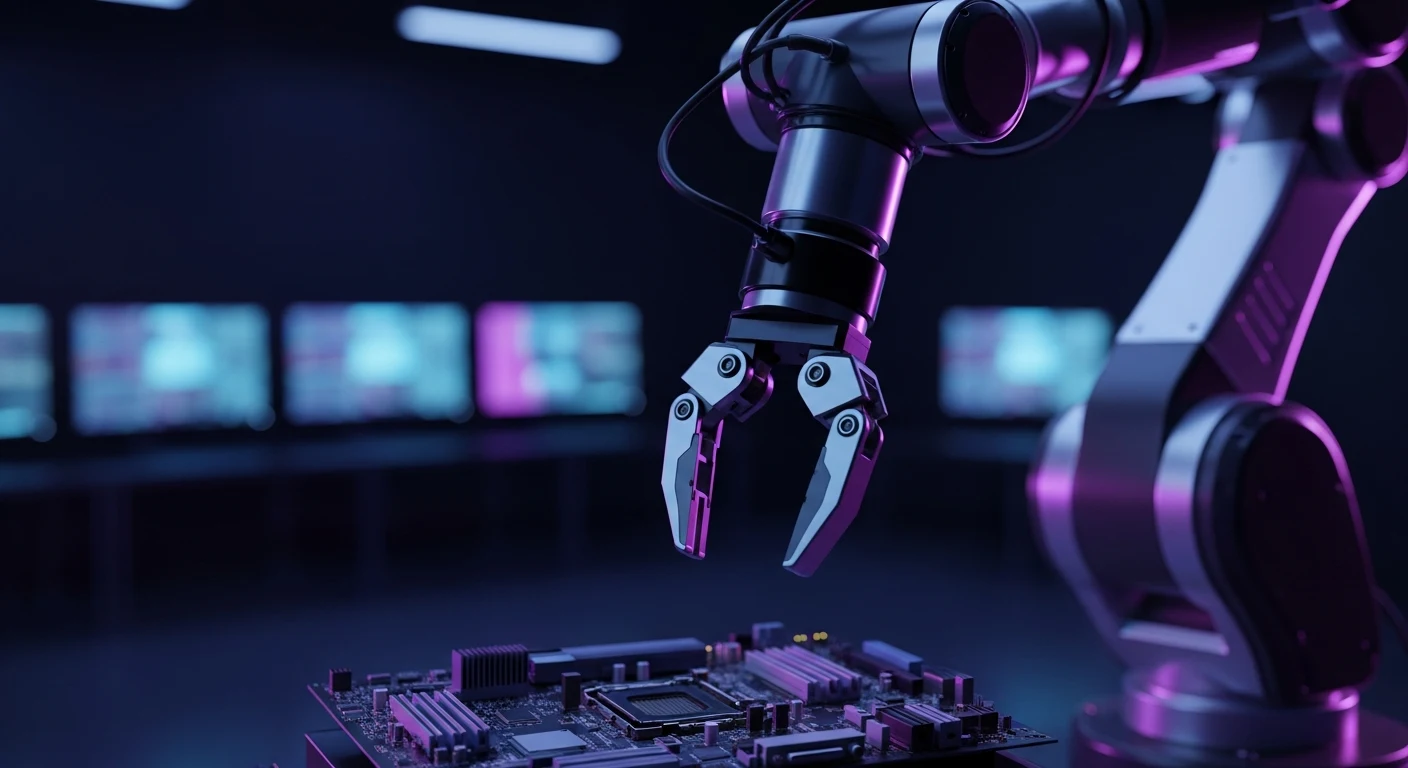
Instead of humans writing the curriculum, researchers simply give the AI agents a set of goals, access to compute resources, and a "generous token budget." The agents take it from there. In recent tests, these AI instructors successfully taught robotic arms how to perform highly delicate and complex tasks, such as cleanly snipping plastic zip ties and precisely inserting graphics cards (GPUs) into the narrow sockets of computer motherboards.
These specific tasks are notable because they require a high degree of spatial awareness, precision, and force feedback—skills that are notoriously difficult to hard-code into a machine. To achieve this, ENPIRE acts as a sophisticated harness around the AI models. It equips the software agents with essential teaching tools, including memory to track progress, contextual awareness of the environment, constraints to prevent damage, and continuous feedback loops to correct the robot's mistakes during trial and error.
The implications of this autonomous training cycle are profound. Jim Fan, Director of AI at Nvidia, highlighted the dramatic shift in their daily workflow, noting that a portion of the GEAR lab now "self-improves tirelessly overnight." Human researchers no longer need to babysit the learning process; they simply arrive in the morning with their coffee and read the progress reports generated by the AI.
This breakthrough signals a critical turning point for embodied intelligence. By removing the human bottleneck from the training loop, the speed at which physical robots acquire new skills could soon match the exponential pace of software development. If AI can figure out how to teach a robot to install a GPU today, it is only a matter of time before it autonomously teaches machines to fold laundry, assemble complex machinery, or assist in delicate manufacturing—all while we sleep.
Key Points
- A new framework called ENPIRE allows AI models to autonomously train physical robots.
- The system was developed by Nvidia GEAR lab in collaboration with CMU and UC Berkeley.
- AI agents successfully taught robotic arms delicate tasks like inserting GPUs and cutting zip ties.
- The framework gives AI memory, constraints, and feedback loops to act as a tireless virtual instructor.
- This shift allows robotics labs to "self-improve overnight" without constant human supervision.
Why It Matters
By automating the process of teaching robots physical tasks, the robotics industry can bypass its biggest bottleneck: the need for slow, manual human programming.
Sources:
- AI coding agents taught robots how to install GPUs and cut zip ties — Ars Technica AI