
The Puppet Strings Beneath the Skin: How Ultrasound and AI Give Robots Human Dexterity
For all the rapid advancements in artificial intelligence, robots remain notoriously clumsy. While an AI model can pass a bar exam or generate photorealistic...
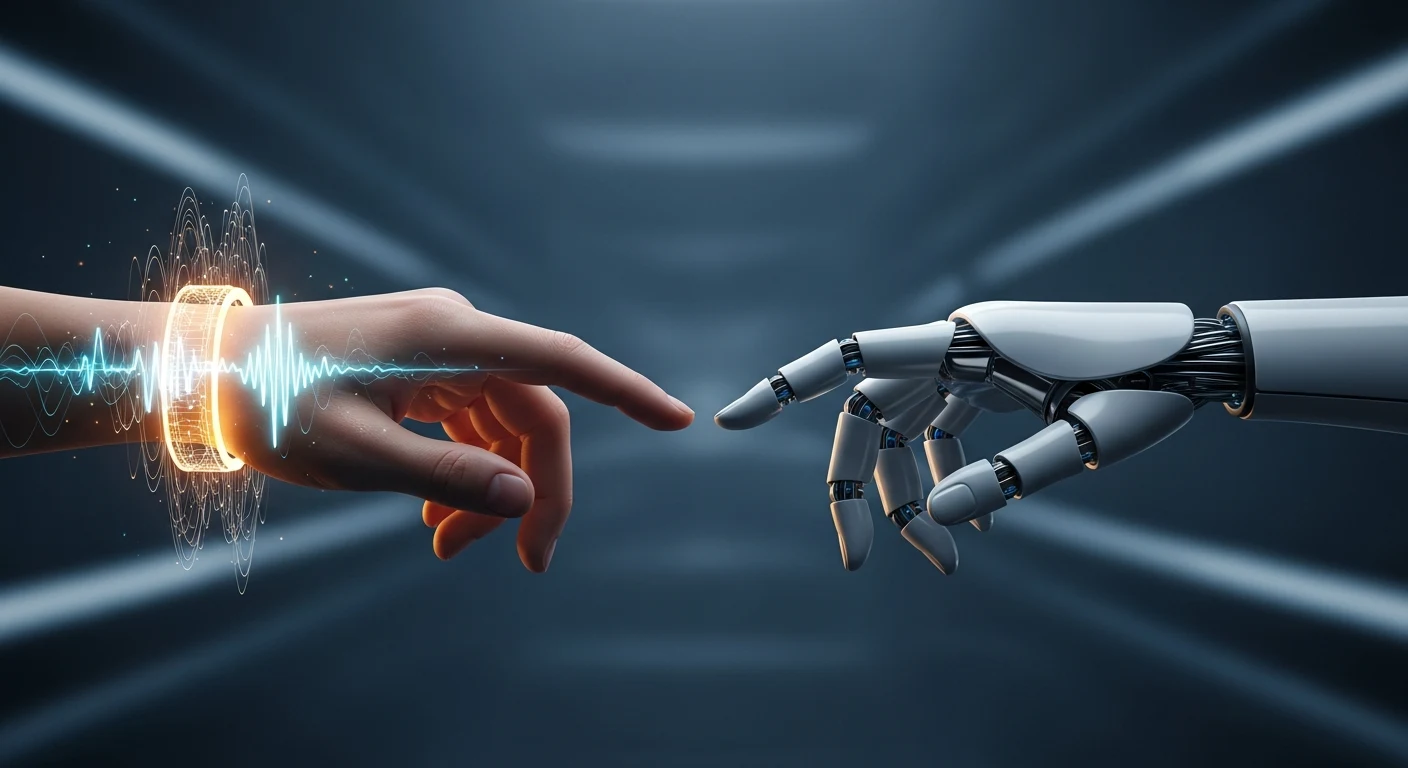
For all the rapid advancements in artificial intelligence, robots remain notoriously clumsy. While an AI model can pass a bar exam or generate photorealistic art in seconds, teaching a robotic hand to seamlessly pick up a slippery pen or play a chord on a piano has remained a profound engineering bottleneck. The human hand is an anatomical marvel, coordinating 34 muscles and over 100 tendons and ligaments. Capturing that physical complexity from the outside using cameras or bulky motion-capture gloves has proven incredibly difficult.
Now, a team of researchers from MIT and the University of Southern California has decided to look beneath the skin. They have developed a novel wristband that uses ultrasound technology to watch the internal mechanics of the wrist, pairing it with machine learning to decode human intention.
The device uses a miniaturized ultrasound "sticker" coupled with hydrogel to safely adhere to the wearer's skin. As the hand moves, the ultrasound captures real-time images of the sliding muscles, tendons, and ligaments. "The tendons and muscles in your wrist are like strings pulling on puppets, which are your fingers," explains Gengxi Lu, a former MIT postdoc. By photographing the state of these biological "strings," the system knows exactly what the hand is doing. An AI algorithm, trained on meticulously labeled ultrasound images, then instantly translates these internal biological shifts into precise finger and palm positions.
The results are akin to a wireless, digital marionette. In laboratory demonstrations, a human wearing the wristband can effortlessly command a robotic hand across the room. When the human gestures, the robot mirrors the action with enough dexterity to play a simple tune on a piano or shoot a miniature basketball into a desktop hoop. The interface works in the digital realm, too—wearers can pinch their fingers in the air to zoom in and out on virtual objects on a computer monitor.
While the current prototype is roughly the size of a smartphone, the research team, led by MIT mechanical engineering professor Xuanhe Zhao, plans to aggressively miniaturize the hardware. They are also expanding their AI training data to accommodate a wider variety of hand shapes, sizes, and gestures.
This breakthrough hints at a future where our interaction with both physical robots and virtual environments feels entirely natural. From enabling surgeons to perform delicate remote operations through humanoid proxies, to giving designers and gamers unprecedented tactile control in virtual reality, the ability to seamlessly translate human intention into robotic action is getting closer. By looking inward at our own biology, we might finally teach machines how to interact gracefully with the world around us.
Source: MIT Technology Review
Key Points
- A new wristband uses miniature ultrasound technology to track the movement of muscles and tendons inside the wrist.
- An AI algorithm decodes these internal movements, acting like puppet strings, into precise finger and hand gestures.
- Users have successfully controlled a robotic hand to play the piano, shoot a mini basketball, and manipulate virtual objects.
- Researchers plan to miniaturize the device further and expand its applications to fields like remote surgery and VR.
Why It Matters
By bypassing external motion tracking and directly reading the body's internal biomechanics, this technology bridges the gap between human dexterity and robotic capability, promising safer and more intuitive human-machine collaboration.
Sources:
- Ultrasound imaging turns a robot hand into a skillful mimic — MIT Technology Review - AI